
Suffering Is Not One Thing
One of the easiest mistakes Christians make when talking about suffering is treating every painful experience as if it belongs to the same theological category.
It doesn’t.
A cancer diagnosis is not automatically persecution. A failed business is not automatically spiritual warfare. A broken marriage is not automatically an attack from Satan. Poverty is not automatically evidence of holiness. And being criticised for doing something foolish is not the same thing as suffering for Christ.
Scripture gives us enough categories to know that we should be more careful.
Sometimes suffering comes simply because we live in a world where bodies become sick, people die, economies collapse, relationships fracture and circumstances can change without warning.
Sometimes suffering follows our own choices.
Sometimes another person’s sin becomes our suffering.
Sometimes suffering is unjust and undeserved.
And sometimes suffering comes specifically because we belong to Christ.
Those categories can overlap. But they should not be casually collapsed into one.
Some Suffering Is Simply Part of Life
Jesus never promised His followers an existence protected from every ordinary hardship of life.
People get sick. People age. People die. Businesses fail. Crops fail. Relationships change. Children struggle. Accidents happen. Economies weaken. Natural disasters destroy homes. Bodies sometimes betray us.
Being a Christian does not create immunity from living in a fallen world.
This matters because a theology that interprets every hardship as a spiritual event can make ordinary suffering unnecessarily frightening.
You may need a doctor rather than deliverance.
You may need financial planning rather than a prophecy.
You may need counselling rather than someone shouting louder at a demon.
You may need rest, treatment, education, a job, a lawyer, a mechanic, a conversation, a boundary or practical help.
Prayer does not make those things unnecessary.
Sometimes We Need to Own What Is Ours
There is another uncomfortable category: suffering that follows our own decisions.
A person who repeatedly spends more than they earn may eventually face financial crisis. A person who repeatedly lies may destroy trust. A person who neglects their health may eventually face consequences. A person who behaves recklessly may create danger for themselves and others.
We should not automatically baptise the consequences of our decisions as spiritual warfare.
Christian accountability means asking an honest question:
What part of this belongs to me?
Sometimes the faithful response to suffering begins with repentance, correction and responsibility.
That isn’t condemnation.
It is freedom.
You cannot change what you refuse to acknowledge.
Sometimes Someone Else Is Responsible
But personal accountability must not become another way of blaming victims.
Sometimes the thing hurting you is something someone else did.
Betrayal. Abuse. Exploitation. Violence. Corruption. Injustice. Manipulation. Abandonment.
Scripture does not require us to pretend those things are our fault.
Nor does faith require us to remain indefinitely in situations where legitimate protection or escape is available.
There is a difference between forgiveness and pretending that nothing happened.
There is a difference between trusting God and refusing to seek safety.
There is a difference between carrying a cross and allowing someone else to repeatedly destroy you without resistance.
Discernment matters because Christian endurance is not the same thing as helplessness.
Suffering for Christ Is Different
This is where the distinction becomes especially important.
The New Testament speaks about suffering that comes specifically because a person belongs to Christ.
Jesus warned His disciples that the world would sometimes hate them because it had hated Him first. Peter distinguishes suffering as a Christian from suffering because of wrongdoing. Paul speaks about the privilege and cost of suffering for Christ.
That is not the same category as simply having a difficult life.
Losing a job because you repeatedly failed to work is not persecution.
Losing a job because you refused to participate in corruption may be.

Being imprisoned because you committed a crime is not suffering for Christ.
Being imprisoned because you proclaimed Christ is a very different matter.
And in some places and circumstances, proclaiming Christ can carry an even greater cost: violence and death.
Christianity has never hidden that possibility from its followers.
The cost of discipleship can include reputation, relationships, employment, possessions, freedom—and, for some believers, life itself.
That is precisely why Jesus told people to count the cost before following Him.
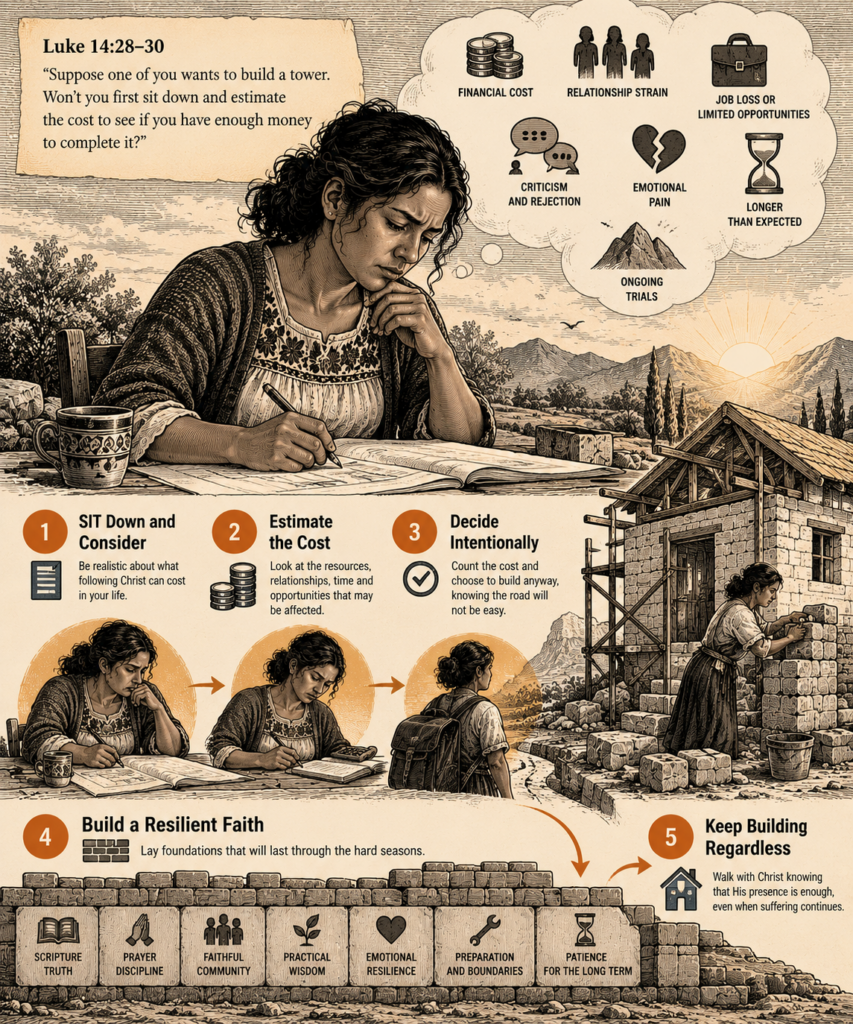
Jesus Told You to Count the Cost
Jesus did not recruit disciples by promising that following Him would make their earthly lives easier.
In Luke 14, He speaks about someone wanting to build a tower.
Before beginning, that person sits down and estimates the cost. Jesus then speaks about a king considering whether he has enough strength to face another king in war.
Then He applies the principle to discipleship.
“In the same way, those of you who do not give up everything you have cannot be my disciples.” — Luke 14:33
The point is not that Christians should deliberately make themselves miserable.
It is that discipleship is a decision with consequences.
Before you follow Christ, you should understand that obedience may affect your future.
It may affect your career.
It may affect your business.
It may affect your friendships.
It may affect your marriage.
It may affect your relationship with your family.
It may affect where you can safely live or work.
And depending on where you live, the cost can be dramatically different.
Jesus is not trying to frighten people away from discipleship.
He is refusing to deceive them about what discipleship costs.
Count the cost.
That is not a theology of fear.
It is a theology of informed commitment.
Joseph Looked for a Way Out
Joseph gives us another side of the story.
Joseph suffered unjustly. He was betrayed by his brothers, sold into slavery, falsely accused and imprisoned.
But notice something easily missed when we turn his story into a lesson about passive endurance.
Joseph tried to get out.
When he interpreted the cupbearer’s dream and knew the man would be restored to Pharaoh’s service, Joseph asked him to remember him.
“When all goes well with you, just remember me and show me kindness; mention me to Pharaoh and get me out of this prison.” — Genesis 40:14
Joseph believed in God’s providence.
Joseph also wanted out of prison.
Those two things were not contradictory.
He could trust God and still pursue a legitimate solution.
He could serve faithfully where he was while looking for a door.
That is a powerful corrective to fatalism.
You are not required to know God’s entire plan before you are permitted to take the next responsible step.
Faith Does Not Cancel Agency
Sometimes Christian language makes agency sound suspicious.
We say, “God is in control,” and quietly turn that statement into, “Therefore there is nothing for me to do.”
But Scripture does not reason that way.
Faith and action repeatedly appear together.
Noah built.
Nehemiah planned.
Joseph served and sought release.
Paul travelled, reasoned, worked, appealed legal decisions and escaped danger when possible.
Jesus Himself sometimes withdrew from hostile crowds because His hour had not yet come.
So trusting God does not mean refusing available means.
You can pray for healing and see a doctor.
You can pray for provision and apply for work.
You can pray for your marriage and seek counsel.
You can pray for protection and leave danger.
You can trust God and learn a skill.
You can believe in providence and still make a plan.
Providence does not cancel agency.
What If God Doesn’t Fix It?
This is where the theology gets difficult.
Christians often reach for sentences that sound comforting but can become dangerous when applied carelessly.
“Everything happens for a reason.”
“God will never give you more than you can handle.”
“Just have faith.”
“Declare your healing.”
“Everything will work out.”
But sometimes the outcome does not work out the way we wanted.
Joseph eventually left prison. But not everyone in prison does.
Job’s story ends in restoration. That does not mean every grieving parent receives another child.
Paul prayed repeatedly about his “thorn in the flesh,” and the answer he received was not the removal of it.
Jesus prayed in Gethsemane that the cup might be taken from Him. The cup was not removed.
He went to the cross.
Christianity cannot honestly promise every suffering Christian the ending they want.
It can promise that suffering does not have the final word.
Suffering Is Not Always Punishment
One of the most destructive responses to suffering is the immediate search for someone’s secret sin.
Someone becomes sick, and we ask what they did.
A child struggles, and we ask what the parents did wrong.
A business collapses, and we assume God must be judging the owner.
A marriage breaks, and we start searching for the spiritual explanation before we know the facts.
The disciples did something similar in John 9 when they encountered a man who had been blind from birth.
“Rabbi, who sinned, this man or his parents, that he was born blind?” — John 9:2
Jesus refused their simplistic equation.
That should make us cautious.
We should not manufacture explanations where Scripture has not given us one.
Sometimes the most faithful sentence available is:
“I don’t know why this happened.”
Not knowing is uncomfortable.
But an honest “I don’t know” is better than a confident theological explanation that God never gave us.
Faith Does Not Require Pretending Nothing Is Wrong
Faith does not mean looking at a broken situation and declaring that it isn’t broken.
The Psalms are full of people telling God exactly what hurts.
Job did not spend his story pretending everything was fine.
Paul acknowledged weakness.
Jesus wept at Lazarus’ tomb.
And in Gethsemane, Jesus did not perform emotional strength for His disciples. He prayed in anguish.
There is nothing unfaithful about acknowledging pain.
There is nothing unfaithful about seeking treatment.
There is nothing unfaithful about asking for help.
There is nothing unfaithful about admitting that you don’t understand what God is doing.
Faith does not require intellectual paralysis.
Sometimes faith looks like asking God for a miracle.
Sometimes it looks like making an appointment with the doctor tomorrow morning.
Sometimes it is both.
What Is Faith When God Says No?
Shadrach, Meshach and Abednego give us one of Scripture’s clearest pictures of faith without presumption.
They believed God could rescue them from the furnace.
But they also said:
“But even if he does not… we will not serve your gods.” — Daniel 3:18
That little phrase changes everything.
But if not.
Faith is not necessarily:
“I believe God will give me the outcome I want.”
Faith can be:
“I believe God is trustworthy even when I do not know what He will do.”
That is a harder faith.
It does not depend upon the miracle arriving on schedule.
It does not require the diagnosis to disappear before God can be called good.
It does not require the marriage to survive before God can be trusted.
It does not require the business to recover before God is worthy of worship.
And it does not require the believer to pretend that the suffering isn’t real.
Sometimes the Most Christian Thing Is to Sit Down
There is something else we learn from Job.
His friends did not begin badly.
They came to him. They saw his suffering. They mourned with him. They sat with him. And for a period, they said nothing.
Sometimes that is exactly what suffering people need.
Not an explanation.
Not a prophecy.
Not an accusation.
Not a lecture about faith.
Someone willing to sit down.
Job’s friends became increasingly problematic when they became certain they understood why Job was suffering.
Their explanations were neat.
Job’s reality was not.
There is a lesson here for Christian communities.
Sometimes presence is more faithful than explanation.
We should be careful about using theology to make someone else’s suffering emotionally easier for ourselves.
Christ Does Not Leave Us Alone in Suffering
Christianity does not ultimately answer suffering by handing us an explanation.
It gives us Christ.
Christianity makes the astonishing claim that God did not remain distant from human suffering.
He entered it.
Jesus knew hunger.
He knew exhaustion.
He knew betrayal.
He knew rejection.
He knew grief.
He knew physical suffering.
He knew what it meant to pray for the cup to pass and then walk toward the cross.
This does not explain every instance of suffering.
But it tells Christians something profoundly important:
God is not asking you to enter a place where He has never been.
And the resurrection adds another dimension.
Suffering and death are real.
But they are not ultimate.
What Do We Do While We Wait?
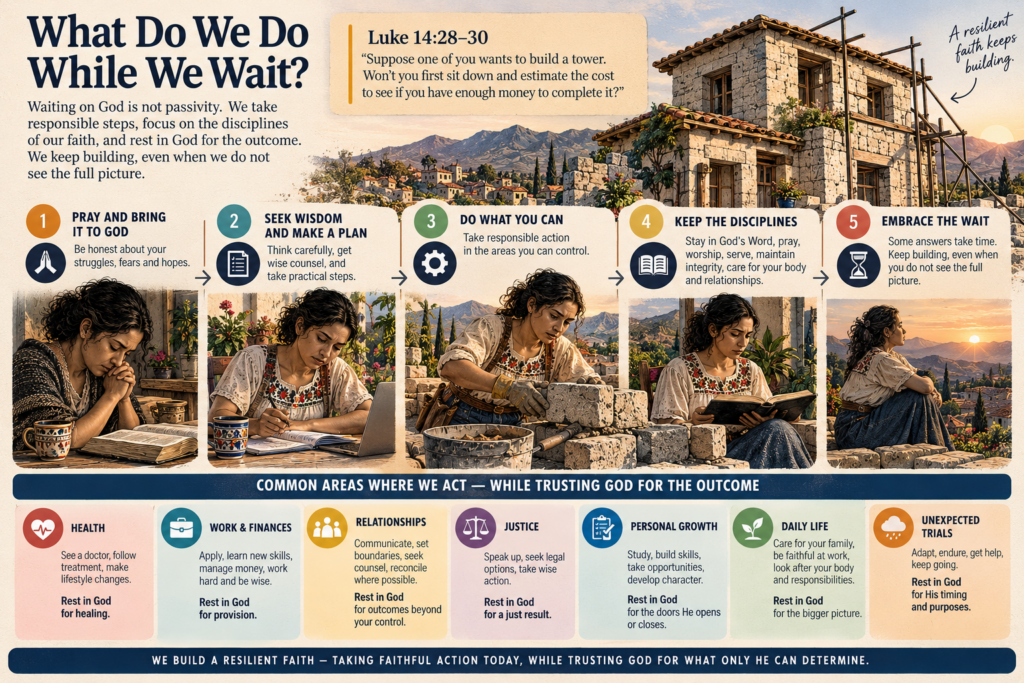
This may be the most practical question in the entire discussion.
If we don’t know whether God will remove the suffering, what do we actually do?
We discern.
We pray.
We investigate.
We take responsibility for what belongs to us.
We seek help where help is available.
We pursue legitimate solutions.
We resist injustice where resistance is possible.
We leave danger when leaving is necessary and possible.
We accept consequences when we have genuinely done wrong.
We count the cost when obedience to Christ places us in difficult circumstances.
And when suffering comes specifically because we belong to Christ, we do not assume that escape is always the highest good.
There are moments when faithfulness means standing.
There are moments when faithfulness means leaving.
There are moments when faithfulness means fighting.
There are moments when faithfulness means enduring.
Wisdom is knowing which moment you are in.
Faith does not tell you to stop thinking. Faith gives you a reason to think carefully about what faithfulness requires.
The Faith That Survives the Day the Miracle Doesn’t Come
Maybe you will be healed.
Maybe you won’t.
Maybe the marriage will survive.
Maybe it won’t.
Maybe the business will recover.
Maybe you will have to rebuild something completely different.
Maybe the door will open.
Maybe you will spend longer than you expected waiting outside it.
Christianity does not give us permission to know the ending before the final page.
But it does give us a way to live before we know the ending.
We can refuse fatalism.
We can refuse presumption.
We can refuse to call every hardship persecution.
We can refuse to call every illness punishment.
We can refuse to blame the devil for everything we ourselves chose.
We can refuse to pretend that suffering is not painful.
And we can refuse to assume that God’s goodness depends upon giving us the outcome we requested.
Sometimes the faithful response is to search for the door.
Sometimes it is to endure while the door remains closed.
Sometimes it is to count the cost and stand when compromise would be easier.
And sometimes the cost of standing for Christ is extraordinarily high.
The Christian faith has never promised that everyone who faithfully proclaims Christ will survive every persecution.
It promises something deeper than earthly immunity.
Christ remains worth following even when following Him costs us something.
So perhaps the question is not only:
“Why is God allowing this?”
Perhaps we also need to ask:
“What kind of suffering is this?”
“What part of it belongs to me?”
“What can I legitimately do about it?”
“What is God asking me to endure?”
“What is He asking me to change?”
“And if following Christ costs me something I cannot avoid, will I still remain faithful?”
That is a faith that can survive more than a successful testimony.
It is a faith that can survive the day the miracle doesn’t come.
Because the foundation of Christian faith was never the promise that nothing painful would happen to us.
The foundation is Christ.
Key Takeaways
- Not every form of suffering is persecution or suffering for Christ.
- Some suffering is part of living in a fallen world.
- Some suffering follows our own decisions and requires accountability.
- Some suffering is caused by the wrongdoing of others.
- Suffering specifically because of allegiance to Christ is a distinct biblical category.
- Jesus taught prospective disciples to count the cost of following Him.
- Counting the cost includes recognising that discipleship can affect relationships, work, business, family, freedom and, in extreme circumstances, life itself.
- Joseph trusted God’s providence while actively seeking a way out of prison.
- Faith does not require passivity or intellectual paralysis.
- God’s goodness is not measured by whether He gives us the outcome we requested.
- “But if not” is still faith.
- Sometimes the most faithful response to suffering is presence rather than explanation.
- The Christian response to suffering requires discernment, responsibility, prayer, wisdom and perseverance.
Reader Action
If you are suffering, resist the temptation to immediately force your experience into a single explanation.
Ask yourself:
- What kind of suffering am I actually experiencing?
- Is there anything here for which I need to take responsibility?
- Is someone else’s wrongdoing contributing to this?
- Are there legitimate practical solutions I have not pursued?
- Am I confusing ordinary suffering with persecution?
- If this suffering is connected to my faithfulness to Christ, what does faithfulness require now?
- What would it mean to trust God without presuming that I know what He will do?
Then take the next responsible step you can actually take.
Sources & Scripture
Biblical passages engaged in this essay include Genesis 40; Daniel 3; Matthew 10; Matthew 16; Luke 9; Luke 14; John 9; John 15; John 16; Acts; Romans 5; Romans 8; 2 Corinthians 12; Philippians 1; 1 Peter 4; and Hebrews 4–5.
Scripture references should be checked against the translation used by the publication before final publication. The article distinguishes explicit biblical teaching from theological inference and does not assume that every instance of suffering has a revealed explanation.