
The Uncomfortable Truth in the Pews
The modern church has spent decades arguing about whether Christians should tithe.
Pastors preach it.
Christians debate it.
Some people calculate it down to the last cent.
Others quietly resent the pressure.
And plenty of Christians simply don’t give ten percent.
The exact percentage varies depending on the survey, population and definition of giving. Barna’s research has found significant differences between practicing Christians and Christians more broadly, while other surveys of evangelical giving have found average giving well below ten percent.
That should make us ask a better question than:
“Why are Christians so disobedient?”
Perhaps some are.
But that cannot explain everything.
Some Christians are poor.
Some are supporting extended families.
Some are carrying medical expenses.
Some are paying off destructive debt.
Some are giving generously outside the institutional church.
Some are serving with their time, expertise and labour.
And some have simply been taught a theology of giving that reduces the entire conversation to one number.
That last problem deserves more attention.
Because if we want Christians to become generous people, we need more than a payment target.
We need to form people who understand stewardship.
The Historical Mismatch: No Temple, No Land, No Ancient Tithe System
The first question should be obvious.
What exactly was the Old Testament tithe?
It wasn’t created in a modern salary economy.
Israel was a covenant nation living in a particular land, with particular institutions, particular worship structures and particular responsibilities.
The tithe belonged inside that world.
Deuteronomy describes agricultural produce and livestock.
The tithe was connected to worship at the place God chose, communal celebration and provision for Levites and vulnerable people.
That context matters.
Because you cannot simply take a biblical institution out of its economic and covenantal environment, replace its underlying material structure with a modern salary, and then assume that nothing theological has changed.
The modern Christian works for a company.
Gets paid in money.
Pays taxes.
Pays rent or a mortgage.
Uses banking systems.
Buys food from supermarkets.
And transfers money electronically.
Ancient Israel did not operate like this.
That doesn’t make the biblical principle irrelevant.
It means we have to distinguish the principle from the historical form in which that principle operated.
What the Biblical Tithe Actually Was
This is where the conversation becomes particularly important.
The biblical tithe was fundamentally material.
Produce.

Livestock.
The things an agricultural society actually produced.
Deuteronomy 14 describes Israelites bringing the tithe of their grain, wine, oil and firstborn of their herds and flocks to the place God chose.
But then comes an interesting provision.
What happened if the journey was too far?
The Israelite could convert the value of the tithe into money because carrying large quantities of produce or livestock over a long distance would be impractical.
But here’s the part we must not flatten.
The money was not the final form of the tithe.
It was the transport mechanism.
The Israelite travelled with the money and then used it to purchase cattle, sheep, wine or other goods for the prescribed celebration.
The basic flow was:
Produce / Livestock → Money for Transport → Purchase of Goods → Celebration Before the Lord
That distinction matters enormously.
The biblical text does not simply say:
“Take ten percent of your salary and put the cash in the religious institution.”
It describes a material economy of worship, provision, celebration and community.
And the tithe itself was not merely a private transaction between an individual and a religious organisation.
It had social consequences.
It involved Levites.
It involved households.
It involved worship.
And in the broader tithe legislation, it involved people such as resident foreigners, orphans and widows.
That is already much bigger than the modern question:
“Did you give ten percent of your salary to church?”
The biblical question concerns what God has provided, how that provision is used, who participates in the worshipping community and how those with fewer resources are cared for.
The Double Standard: Money Counts, But Labour Somehow Doesn’t
Churches sometimes argue that Christians must give money because we live in a monetary economy.
Fair enough.
But then the same churches can behave as though the five hours a qualified electrician spends repairing the building are somehow worth less because no money changed hands.
That makes no economic sense.

If the church had hired the electrician, those five hours would have appeared on an invoice.
The value existed before the invoice.
The same is true of the builder who repairs the roof.
The accountant who handles the books.
The sound engineer who runs the service.
The cleaner who prepares the building.
The driver who transports elderly members.
The person who cooks for a struggling family.
The believer who spends hours praying for people.
Money is one way of measuring value.
It is not the only way value exists.
And this becomes even more interesting when we return to the biblical tithe.
The Old Testament tithe was not originally structured as a monthly transfer of 10% of someone’s salary into an institutional bank account.
Deuteronomy describes the tithe in terms of agricultural produce and livestock.
When the journey to the sanctuary was too long, Israelites could convert the tithe into money for the journey—but once they arrived, that money was used to purchase cattle, sheep, wine or other goods for the prescribed celebration.
The money solved a transportation problem.
It did not redefine the underlying substance of the tithe.
That distinction matters.
Because we should be careful about taking the ancient 10% figure out of its agricultural, covenantal and communal setting, turning it into a modern salary formula, and then declaring the resulting formula to be the universal definition of Christian generosity.
Scripture gives us something much bigger.
It gives us stewardship.
It gives us generosity.
It gives us responsibility.
It gives us sacrifice.
It gives us care for people.
And it gives us a community in which what God has entrusted to one person can become a blessing to someone else.
The question is therefore not simply:
“How much cash did you put in the offering?”
The better question is:
“What have you been entrusted with, and how faithfully are you using it?”
The Grace Trap: “We’re Under Grace” Does Not Mean “Give Nothing”
Now we need to avoid swinging to the other extreme.
Because once someone discovers that the Old Testament tithe cannot simply be copied and pasted into a modern salary formula, a second argument often appears:
“Christians are under grace, not law. Therefore tithing doesn’t matter.”
That conclusion doesn’t follow.
Grace is not God’s permission to become stingy.
The New Testament repeatedly calls Christians to generosity.
Paul spends significant time teaching the churches about giving.
The Macedonian believers gave despite their own hardship.
Jesus praised the widow who gave sacrificially.
The early church shared resources so that people in genuine need could be cared for.
The question is therefore not whether Christians should give.
They should.
The question is what governs that giving.
Fear?
Legalism?
A promised financial return?
Social pressure?
Or grace-shaped stewardship?
That distinction matters.
So Where Does Ten Percent Fit?
Ten percent can be a useful discipline.
It can provide a concrete starting point.
It can help someone who has never developed a habit of giving.
It can force a person to recognise that their resources do not belong exclusively to themselves.
But a useful discipline is not automatically the same thing as a universal New Covenant law.
That distinction needs to be made carefully.
If someone gives ten percent mechanically while remaining greedy, dishonest, exploitative or indifferent to people in need, the percentage itself has not transformed the heart.
And if someone gives more than ten percent because they have greater capacity and a deeper conviction of responsibility, the fact that they have technically exceeded the percentage does not mean they have completed their duty to love.
The number can therefore become a strange kind of spiritual ceiling.

“I’ve done my ten percent.”
And now what?
Can I ignore the struggling family next door?
Can I refuse to help someone because the giving category has already been completed?
Can I spend everything else on myself without asking whether God has entrusted me with more?
That is where the percentage can become a distraction.
Ten percent may discipline the hand.
But Christian stewardship is concerned with the whole life.
The Real Test Is the Heart
The New Testament’s language of generosity repeatedly moves beneath the amount.
Paul tells the Corinthians that giving should not be extracted through reluctance or compulsion.
He points toward willingness.
He points toward generosity.
He points toward proportion.
And he points toward the grace of Christ.
That changes the emotional centre of the conversation.
The question is no longer:
“Are you afraid enough to give?”
It becomes:
“Has the grace of God changed the way you see what you possess?”
That is much harder to fake.
A person can hand over ten percent and still worship money.
Another person can give sacrificially, serve practically, provide for family, support people in crisis and use their skills to strengthen the church without ever fitting neatly into a single percentage formula.
Christian generosity cannot be reduced to accounting.
But neither should generosity become so vague that it never costs us anything.
Grace should produce actual sacrifice.
The heart should be tested by what we do with what we have.
What About Church Buildings and Infrastructure?
There is another conversation hiding underneath the tithing debate.
What exactly are churches supposed to fund?
Some Christians imagine that money given to church should only support explicitly spiritual activity.
Others treat the church building as though maintaining it is itself sacred.
Neither extreme is necessary.
A church can meet in a house.
It can meet under a tree.
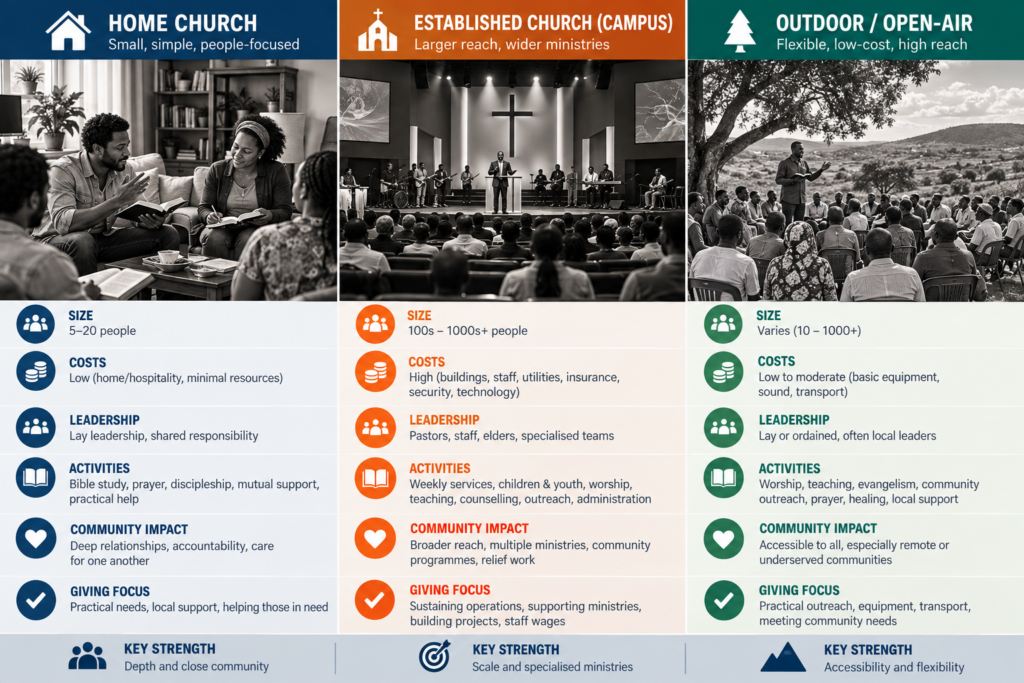
It can meet in a rented hall.
It can meet in a simple building.
It can meet in a large, expensive facility.
The building is not the church.
But buildings can serve people.
A safe building can provide shelter.
A kitchen can feed people.
A classroom can teach children.
A meeting hall can provide community.
A counselling room can provide privacy.
A functioning facility can become a place where people gather, learn, mourn, celebrate, receive help and worship.
So infrastructure is not automatically wasteful.
The question is whether the infrastructure serves the mission or gradually becomes the mission.
The church can own a multimillion-dollar building and still proclaim Christ faithfully.
A church can meet in a tiny room and still become obsessed with money.
The physical size of the building does not determine the spiritual health of the church.
The centre must remain Christ.
Salvation.
Repentance.
Scriptural truth.
Discipleship.
Love of God and neighbour.
Faithful stewardship.
When Giving Becomes a Tool of Control
This is where the conversation becomes dangerous.
There is a profound difference between teaching generosity and using fear to extract money.
“Give because God has been gracious to you” is one kind of message.
“Give this amount or God will punish you” is another.
“Give because you love people” is one thing.
“Give because this payment unlocks your financial breakthrough” is another.
The first points toward worship.
The second can turn worship into a transaction.
And once giving becomes transactional, the offering plate starts to resemble an investment account.
Give seed.
Expect harvest.
Increase the seed.
Expect a greater harvest.
The language sounds biblical because Scripture contains agricultural metaphors for generosity.
But the theology can quietly become commercial.
God becomes the return mechanism.
The offering becomes the investment.
The believer becomes the investor.
And the desired blessing becomes the expected dividend.
That is not the same thing as Christian generosity.
Christian giving begins with God.
It does not attempt to put God in debt to us.
What Should Churches Be Accountable For?
If churches are going to ask people to give, churches should also be willing to talk honestly about stewardship.
Where does the money go?
How are leaders compensated?
How much is spent on administration?
How much reaches people in need?
What debt does the church carry?
What assets does it own?
What ministries are being funded?
What obligations are genuinely necessary?
What spending exists because it serves people—and what exists because leaders have become accustomed to it?
Transparency does not undermine faith.
It can strengthen trust.
The New Testament’s concern for handling money honourably should make financial integrity a pastoral issue, not merely an accounting issue.
A church asking members to practise stewardship should model stewardship itself.
The Better Comparison: Percentage or Stewardship?
Imagine two Christians.
The first earns very little.
She gives ten percent.
She also provides food for an elderly relative, volunteers at church, cooks for struggling families and spends her evenings caring for a sick parent.
The second earns twenty times more.
He gives ten percent.
He has no debt, owns multiple properties, spends lavishly on himself and rarely considers the needs around him.
Have we really captured the difference between their generosity by saying they both tithe?
The percentage is identical.
The stewardship is not.
This is why the Christian conversation has to become bigger than the number.
How much do you have?
How did you obtain it?
Who depends on you?
What responsibilities have you been given?
What needs exist around you?
What are you capable of contributing?
What sacrifices are appropriate?
What would generosity look like at your level of capacity?
And perhaps the most uncomfortable question:
“What would God say I am stewarding badly?”
That question cannot be answered by a calculator.
“Pastors should be fairly compesated because as believers we know theyre doing work regardless that non believers believe its not work or worthy of compesation. However, this shouldnt be used to manipulate and swindle od’s people.”
Stop Treating the Offering Plate Like a Transaction
The point of this argument is not to give Christians an excuse to give less.
It is to give Christians a bigger reason to give faithfully.
The Old Testament tithe was part of a particular covenantal economy.
It involved produce.
It involved livestock.
It involved worship.
It involved communal celebration.
It involved Levites.
It involved care for vulnerable people.
And when distance required it, the material value could be converted into money for transportation before being converted back into goods at the destination.
That is not the same thing as a modern salary deduction formula.
But neither does the difference release Christians from generosity.
Grace should make us more attentive to what God has entrusted to us, not less.
And stewardship should include more than cash.
Your money matters.
Your time matters.
Your skills matter.
Your property matters.
Your knowledge matters.
Your relationships matter.
Your physical labour matters.
Your ability to build matters.
Your ability to teach matters.
Your ability to repair matters.
Your ability to care for people matters.
The Christian life is not a subscription service where you pay ten percent and receive a spiritually compliant status badge.
It is discipleship.
It is stewardship.
It is worship.
It is love.
It is sacrifice.
It is responsibility.
So perhaps the question we should stop asking is:
“Did I give my ten percent?”
And start asking:
“What has God placed in my hands—and what am I doing with it?”
That question is harder.
But it is also much closer to the heart of stewardship.
Key Takeaways
- The Old Testament tithe belonged to a particular covenantal and economic system.
It involved agricultural produce, livestock, worship, communal celebration and provision for others. - The tithe could be converted into money for transportation, but money was not the final substantive form of the tithe. The money was used to purchase the goods required for the prescribed celebration.
- Christians should not use the difference between Old Covenant tithing and New Covenant giving as an excuse for selfishness. The New Testament repeatedly calls believers to generosity and sacrifice.
- Ten percent can be a useful discipline without necessarily being treated as a universal New Covenant salary formula. If you want to use it as a measure feel free to but dont guilt others who are not convicted to use it.
- Labour has value even when no money changes hands. Professional expertise, repairs, administration, caregiving, transportation, cleaning and practical service can all materially strengthen a church and its people.
- The church should model stewardship rather than simply demand it. Financial transparency and responsible use of resources matter.
- A church building can be useful without becoming the centre of Christian life. The mission remains Christ, salvation, repentance, Scripture, discipleship and faithful stewardship.
- Grace is not permission to give nothing. Grace changes the motive and scope of generosity.
- The deepest stewardship question is not merely how much money you give.
It is what God has entrusted to you and how faithfully you use it.
Reader Action
Before your next financial decision, don’t begin with the percentage.
Ask yourself these questions:
- What has God entrusted to me?
- What responsibilities already belong to me?
- Who benefits from what I have been given?
- Where am I being generous?
- Where am I using money to avoid responsibility?
- Where am I using “stewardship” as an excuse for selfishness?
- What skills, time or labour could I contribute that money cannot replace?
- Is my giving an act of worship—or an attempt to purchase an outcome from God?
Then look at the number.
Not first.
Last.
Because the number should serve stewardship.
Stewardship should never become a substitute for discipleship.
Sources & Further Reading
- Deuteronomy 14:22–29— the biblical description of the tithe, including the provision for converting its value into money when the journey to the sanctuary was too long.
- Deuteronomy 26:12–15— the third-year tithe and provision for Levites, resident foreigners, orphans and widows.
- 2 Corinthians 8–9— Paul’s teaching on generosity, willingness, grace and giving according to ability.
- Mark 12:41–44— Jesus’ teaching concerning the widow’s offering and sacrificial generosity.
- Barna Research — research on Christian giving patterns and the relationship between faith and financial generosity.
- Internal Revenue Service — Churches & Religious Organizations— background on the financial and organisational context in which modern churches operate.