
faith, biology and stewardship
Faith, Biology & Stewardship
Faith, Biology, and Stewardship: Why Recognizing Celiac Disease and Failure to Thrive Isn’t a Lack of Faith
When a child struggles to eat or gain weight, seeking medical understanding is not surrendering faith. It can be an act of stewardship: learning what the body is telling you so you can respond wisely. Celiac Disease and Faith are complicated because wheat plays a central role in an important christian tradition: Communion
“If I accept this diagnosis, am I accepting a curse over my child? Am I confessing sickness instead of health?”
Some believe that naming a medical condition gives room to spiritual attack, or that avoiding specific foods means operating in fear rather than faith.
But Scripture and biology tell a different story.
Understanding how our bodies react to a broken world is not a spiritual defeat.
It is physical stewardship.
You need to define Faith
At its simplest Faith is trusting God regardless.
TL;DR
A medical diagnosis is not a spiritual identity. Failure to thrive describes a physical problem with growth or weight gain; celiac disease is an autoimmune condition that can interfere with nutrient absorption. Recognizing what is happening in a child’s body does not require abandoning faith. It can be part of faithfully caring for the life God has entrusted to you.
Understanding “Failure to Thrive”: A Medical Warning, Not a Spiritual Label
When a doctor mentions Failure to Thrive (FTT), it can sound devastating.
It can feel like a judgment on your household or a permanent declaration over your child’s future.
However, Failure to Thrive is not a curse, a spiritual defect, or a permanent identity.
It is simply a medical description of a physical event: a child’s body is not gaining weight or growing at the expected rate for their age.
For a child to grow, their body needs energy and raw materials.
Failure to thrive occurs when that physical process breaks down in one of three ways:
- Inadequate Caloric Intake:
The child cannot get enough food into their system, often due to pain while eating, severe reflux, or swallowing difficulties. - Increased Energy Needs:
The body burns calories too fast due to chronic physical stress, infection, or underlying conditions. - Malabsorption:
The child eats enough, but their digestive system cannot absorb the nutrients.
When malabsorption is present, food passes through without fueling the body.
The child experiences cellular starvation despite eating regularly.
What Celiac Disease Actually Is (It Is Not a Mindset or a Demon)
Celiac disease is often misunderstood as a trend, a simple preference, or a spiritual affliction.
In reality, it is a serious autoimmune condition that directly causes malabsorption and Failure to Thrive.
When someone with celiac disease eats gluten (a protein found in wheat, barley, and rye), their immune system misidentifies gluten as a dangerous invader and attacks the lining of the small intestine.
| Normal Gut Function | Celiac Disease Reaction |
|---|---|
| Intestinal Villi: Tiny, finger-like projections absorb nutrients from food into the bloodstream. |
Flattened Villi: The immune reaction damages these projections, altering the intestinal lining. |
| Nutrient Absorption: Iron, vitamins, fats, and protein pass into the body for growth and energy. |
Malabsorption: Damage to the small intestine can interfere with nutrient absorption, contributing to problems such as poor growth, anemia and fatigue. |
Removing gluten is not “giving in to sickness.”
It is removing the physical trigger so the body God designed can heal itself.
We Do Not Live in a Pristine Environment
God created the human body with extraordinary wisdom, but we do not live in the Garden of Eden.
Creation experiences decay, and our modern environment is far removed from original conditions.
Our soil health, industrial processing, heavy chemical exposures, and agricultural modifications mean our bodies encounter compounds they were not designed to process smoothly.
Recognizing that modern chemical exposures or altered proteins trigger severe reactions in the body is simply acknowledging reality:
- Our bodies are fearfully and wonderfully made (Psalm 139:14), built with immune systems designed to protect us.
- Our environment contains real hazards, meaning certain substances trigger our immune systems to turn inward and cause inflammation.
Acknowledging that a child’s body is responding negatively to an altered environment is not declaring a curse; it is identifying a physical reality so you can protect them.

The Gut-Brain Connection: Why Body and Mind Are Tied Together
Failure to thrive is not just about numbers on a growth chart.
Malabsorption impacts every system God built into the human body, especially the brain:
- Neurological Impact:
The brain requires healthy fats, B-vitamins, and iron to build neural pathways. Malabsorption caused by gut damage often leads to brain fog, extreme irritability, developmental delays, and mood disruptions. - Neurotransmitter Production:
Science shows that a vast majority of the body’s serotonin, which regulates mood and calm, is produced in the gut. A damaged gut directly impacts emotional and neurological stability. - Physical Energy:
Children experiencing FTT often become abnormally lethargic or exhausted because their cells lack energy.
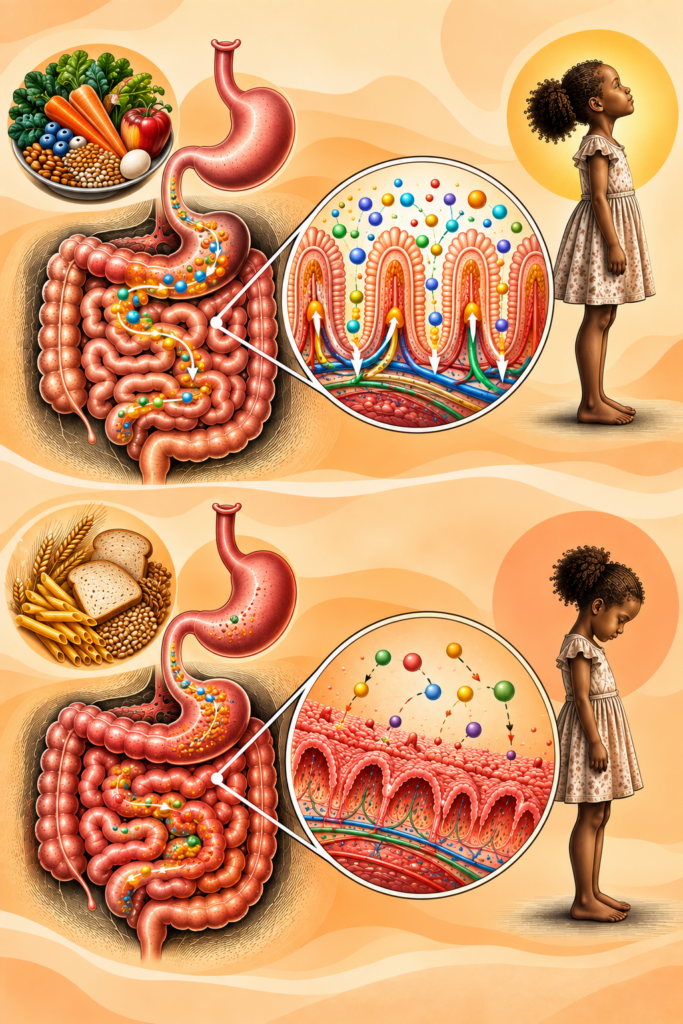
Addressing gut issues and avoiding toxic triggers directly protects a child’s neurological health and emotional well-being.
Stewardship vs. Fear: Identifying Danger Is Wisdom
Proverbs 22:3 tells us:
“A prudent person sees danger and takes precautions. The simpleton goes blindly on and suffers the consequences.”
If a child is severely allergic to bee stings, keeping them away from a hive is not a sign of weak faith—it is wisdom.
The same logic applies to autoimmune triggers, ultra-processed chemical additives, and environmental toxins.
Diagnosing a condition provides essential clarity:
- It removes shame from parents.
You stop blaming yourself for “poor feeding” or “bad parenting.” - It pinpoints the physical obstacle.
Once gluten or harmful triggers are removed, the intestinal lining regrows, nutrient absorption resumes, and the child begins to thrive again. - It honors God’s gift of medical understanding.
Using knowledge to care for a child is an act of love and stewardship.
In John 9, when faced with a man born blind, the disciples asked Jesus who had sinned—the man or his parents.
Jesus corrected them immediately, shifting the focus away from curses and toward God’s works being revealed.
Faith Does Not Require Ignorance
Faith is not the refusal to acknowledge what is physically happening.
A Christian parent does not become more faithful by refusing to investigate why a child cannot eat, why weight is not increasing, or why the body is showing signs that something is wrong.
Seeking understanding does not mean replacing God with medicine.
It means recognizing that physical realities are still realities.
A diagnosis is not a prophecy.
A medical condition is not a declaration of identity.
And a food restriction is not automatically an admission of spiritual defeat.
Sometimes the faithful response is remarkably practical:
find out what is happening, remove what is harming the body, nourish the person, and keep trusting God.
Moving Forward in Faith and Wisdom
If a child or loved one is failing to gain weight, experiencing gut distress, or showing signs of malabsorption, do not let fear keep you from seeking medical clarity.
Testing for celiac disease or identifying environmental sensitivities is not a spiritual compromise.
God gave us bodies that communicate when something is wrong.
Listening to those signals, removing harmful triggers, and nourishing our children with what allows them to thrive is one of the highest forms of care we can offer.
Faith and careful observation do not have to compete.
Wisdom can investigate.
Medicine can identify.
Parents can protect.
And God remains God through all of it.
Recognizing the Body Is Not Rejecting God
There is a particular kind of Christian fear that can make parents afraid to name what is happening in front of them.
But refusing to name a problem does not make the problem disappear.
A child who is struggling to grow needs care.
A child experiencing malabsorption needs investigation.
A child with celiac disease needs protection from the trigger that causes intestinal damage.
None of those actions require a parent to abandon faith.
In fact, they can flow directly from a biblical understanding of stewardship.
The body is not God.
But it is a gift.
And gifts are meant to be cared for.
Faith does not require us to ignore biology. Stewardship asks us to understand it.
Key Takeaways
- Failure to Thrive is a medical description of inadequate growth or weight gain, not a spiritual identity.
- Celiac disease is an autoimmune condition involving an abnormal immune response to gluten and can interfere with nutrient absorption.
- Recognizing a medical condition does not mean accepting a curse over a child.
- Avoiding a known physical trigger can be an act of responsible stewardship rather than fear.
- Physical health, nourishment and neurological development are interconnected.
- Christian parents do not have to choose between faith and seeking medical understanding.
- Wisdom sometimes means identifying danger and taking appropriate precautions.
- A diagnosis describes a condition; it does not define the person.
Reader Action
If you are concerned about a child who is struggling to eat, gain weight or develop as expected, don’t let theological fear prevent you from seeking clarity.
- Talk to an appropriately qualified healthcare professional.
- Ask questions about growth, nutrition, digestion and possible underlying causes.
- If celiac disease is suspected, discuss appropriate testing with the child’s healthcare professional before making major dietary changes.
- Keep track of symptoms, food reactions, appetite and growth information where appropriate.
- Continue praying—but let prayer and wise action work together rather than treating them as opposing choices.
Sources & Further Reading
This article combines biblical reflection with medical and biological claims that should be supported by authoritative clinical sources.
- Biblical references: Psalm 139:14; Proverbs 22:3; John 9.
- Medical sources on celiac disease, gluten, intestinal injury and nutrient malabsorption.
- Clinical guidance on childhood growth and Failure to Thrive.
- Evidence-based sources on nutritional deficiencies and child development.
- Evidence-based research concerning the gut-brain axis and gastrointestinal health.
Medical information in this article is intended for educational purposes and should not replace evaluation or treatment by an appropriately qualified healthcare professional.