
Before the Fall, Work Was Already Good
Genesis 1:28 gives humanity a commission: be fruitful, fill the earth, exercise responsible dominion over the created order. Genesis 2:15 then gives a more intimate picture: the Lord God puts the man in the garden “to work it and keep it.”
Notice when this happens.
Before Genesis 3.
The command comes before the serpent. Before rebellion. Before the ground is cursed. Before work becomes exhausting.
That means work itself cannot be the curse.
Hardship is part of the curse. Frustration is part of the curse. Futility is part of the curse. But purposeful human activity is not.
That is a crucial recovery for Christians who have inherited either of two distorted ideas: that work is merely a necessary evil, or that work is valuable mainly because it produces money.
Biblically, work is more fundamental than either idea. It is part of what human beings were made to do.
Work and the Image of God
Human beings are made in God’s image before they are assigned a salary, profession or social status. Our dignity therefore does not come from our economic output.
But our calling to create, cultivate and order is not accidental either.
Scripture begins with God making. He forms, separates, names, fills, plants and orders. Then He creates human beings in His image and gives them responsibility within that creation.
We are not God. We do not create from nothing. We do not own the world absolutely. But we are invited to participate in the work of cultivating what He has made.
Human creativity is not a rival to God’s creativity. It is one of the ways human beings bear His image.
A carpenter turns timber into something useful. A teacher turns knowledge into understanding. A farmer cultivates a field. A mother and father cultivate a home. A doctor repairs what disease has damaged. An engineer solves a problem. An administrator brings order to complexity. A writer turns ideas into language.
These activities are different, but they share something: they take what has been entrusted and seek to cultivate it toward a useful end.
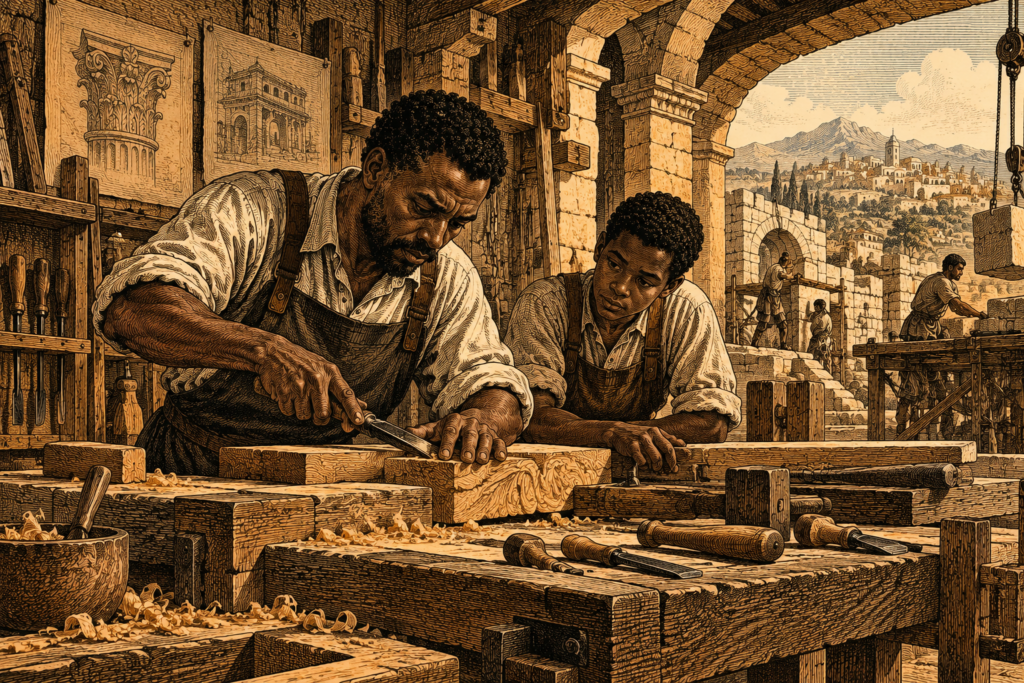
Dominion Is Stewardship, Not Ownership
The word “dominion” can make modern readers nervous, and rightly so when it is interpreted as permission for exploitation. But biblical dominion cannot be separated from the character of the God who gives it.
The Creator does not hand humanity the world and disappear. The earth remains His.
That is why stewardship is a better working concept for Christian thinking about resources and responsibility.
A steward has authority, but not ultimate ownership. A steward can make decisions, but remains accountable. A steward can improve what has been entrusted, but cannot pretend that the trust belongs to him absolutely.
This changes how we think about possessions.
Money is not automatically evil. Land is not automatically evil. Business is not automatically evil. Technology is not automatically evil. Influence is not automatically evil.
The question is what we do with them, what they do to us, and whether our use of them remains accountable to God and oriented toward the good of others.
THE STEWARDSHIP QUESTION
What Work Does to Character
Work does not merely produce things. It reveals and forms people.
Repeated choices create habits. Habits shape character. Character influences how we use responsibility when nobody is watching.
That is why Scripture repeatedly connects ordinary work with faithfulness. Colossians 3:23 tells believers to work wholeheartedly, as for the Lord. Proverbs repeatedly connects diligence, honesty and wisdom with the ordinary responsibilities of life. Paul tells believers to work quietly and live responsibly.
None of this means every job is equally enjoyable, equally paid or equally visible.
It means that faithfulness can be practiced in ordinary places.
The apprentice learns patience. The farmer learns seasons. The builder learns precision. The manager learns responsibility. The parent learns sacrifice. The entrepreneur learns uncertainty. The researcher learns humility before evidence. The servant learns that usefulness does not always come with applause.
Work becomes one of the places where character is tested.
And that gives us a much healthier question than “How successful am I?”
We can ask: What kind of person is my work making me?
Where Wealth Fits
Once we recover the goodness of work, we need to be equally careful not to swing into the opposite error.
Wealth is not the enemy.
Scripture contains wealthy people. It contains warnings about wealth. It contains instructions for generosity, justice, provision and responsible use of resources. It never gives us permission to reduce material resources to a simple spiritual score.
Someone can possess much and be generous. Someone can possess little and be covetous. Someone can earn honestly and still love money. Someone can be poor through injustice rather than personal failure. Circumstances do not provide a simple diagnostic of character.
This is where prosperity theology can confuse a biblical truth with a guaranteed formula.
Yes, faithful work can produce fruit. Wisdom can produce better decisions. Diligence can improve outcomes. Skill can create value. Good stewardship can prevent waste.
But none of those observations becomes a covenant guaranteeing that faithful Christians will become wealthy.
Fruitfulness is a biblical category. Guaranteed prosperity is a theological claim that requires much more than the existence of fruitful work.
Stewardship Includes Limits
If stewardship means responsible care, then stewardship also includes knowing when to stop.
The biblical story does not end with humanity working without limits. Scripture gives rhythms of rest, Sabbath, worship and dependence. Human beings are productive creatures, but we are not machines.
That matters in a culture that can baptize exhaustion as ambition.
We can build a business and still neglect our family. We can increase income and destroy our health. We can accumulate knowledge and become proud. We can build influence and lose integrity. We can become exceptionally productive while becoming spiritually impoverished.
Stewardship asks a wider question.
Not simply: “Can I produce more?”
But: “Is what I am producing worth the person I am becoming?”
The Work Mandate Is Not the Prosperity Promise
This is where our critique of prosperity theology needs precision.
We do not need to argue that God does not bless people materially. He does. We do not need to argue that hard work is meaningless. It is not. We do not need to pretend that wise stewardship has no practical consequences. It often does.
What we must reject is the conversion of these truths into a spiritual mechanism:
Work hard + believe strongly + give financially = guaranteed material increase.
That equation is not the biblical work mandate. It is a transactional interpretation imposed upon it.
Faith does not turn God into a predictable vending machine. Stewardship does not make the steward sovereign. Prayer does not eliminate God’s freedom. And material outcomes cannot become the final measurement of God’s love.
The Christian can work diligently without believing that diligence obligates God to make him rich.
She can build a business without believing that business success proves divine approval.
They can pursue excellence without making achievement an identity.
They can receive abundance with gratitude and endure scarcity without concluding that God has abandoned them.
That is a theology capable of surviving both harvest and drought.

The Question of the Steward
Jesus repeatedly used stewardship language to expose the relationship between possession and responsibility.
The parables of entrusted resources are not simply lessons about getting more. They are about faithfulness with what has been placed in our hands.
That creates a more durable framework for thinking about ambition.
Ambition can ask:
How much can I become?
Stewardship asks:
How faithfully can I use what I have been given?
Those questions are not enemies. A person can pursue excellence precisely because excellence is one way of stewarding ability.
The danger begins when achievement stops being stewardship and becomes self-worship.
Then the gift becomes the identity. The resource becomes the master. The work becomes the god.
Christian stewardship keeps turning the heart back toward the Giver.
Practice: Steward What Is in Your Hands
Start smaller than your ambitions.
Look at what is already in front of you.
- Name it. What has actually been entrusted to you—time, money, skill, knowledge, relationships, tools, influence, land, work?
- Examine it. Are you cultivating it, consuming it, neglecting it or worshipping it?
- Improve one thing. Stewardship often begins with a small act of order: repair something, learn a skill, pay a debt, document a process, teach someone, plant something, finish something.
- Share something. Stewardship is not merely keeping. What you have received can become provision for someone else.
- Give thanks. Gratitude protects stewardship from becoming entitlement.
The goal is not to make yourself impressive.
It is to become faithful.
The Work Is Ours. The Ownership Is God’s.
There is a beautiful tension at the heart of Christian stewardship.
God gives human beings real responsibility. We really build. We really cultivate. We really create. We really make decisions that matter.
And yet we never become ultimate owners.
That frees us from two opposite temptations.
We do not have to be passive, because God has given us work to do.
And we do not have to worship our results, because the world was never ours to own absolutely.
Work faithfully.
Steward carefully.
Build courageously.
Hold the results humbly.
The question is not simply, “How much did you gain?”
It is, “What did you do with what God placed in your hands?”
The Christian vision of work is neither a theology of accumulation nor a theology of resignation.
It is a theology of faithful stewardship.
We work because God gave us work to do.
And we remember who owns the garden.